The Art Inspiration I Found in an Abandoned Building
I spend a lot of time walking around places most people drive past without thinking about. Old blocks behind grocery stores. Streets with half boarded storefronts. The edges of town where buildings sit empty for years while weeds climb through broken pavement. I carry a small sketchbook almost everywhere, though if I am being honest, most days the pages stay blank. I flip through them later and see a lot of unfinished lines and half started ideas. It gets frustrating sometimes. You feel like you should be making something, but nothing quite lands.
The strange thing about drawing is that it looks easy from the outside. People imagine you sitting comfortably at a table with a cup of coffee while ideas arrive politely one after another. That has never been my experience. Most of the time I wander around hoping something catches my eye strongly enough that I stop walking and start sketching. Some days that happens quickly. Other days I walk for hours and end up with nothing but sore feet and the same empty sketchbook I started with.
That afternoon I had already been walking longer than usual. The sky was gray in the flat way that makes the whole town feel slightly faded. I was cutting through a side street I rarely use when I noticed the building. I had probably passed it before, but for some reason it felt different that day. The windows were broken in a few places, and the paint on the outside walls had peeled so badly that whole patches of bare wood showed through underneath. The front door hung crooked on its hinges. It was not dramatic in the way abandoned places sometimes look in movies. It was just quiet and neglected, like something everyone had slowly agreed to forget.
I stood across the street longer than I meant to. Part of me was already imagining the inside. Empty rooms usually have interesting shapes once the furniture disappears. Light behaves differently when windows are cracked or partially boarded. Shadows stretch across floors in odd directions. All those things can create strong visual scenes for drawing, but there was also the obvious problem that the building was not mine to enter.
I told myself I was only going to walk closer and look through the doorway. That felt harmless enough. When I crossed the street the quiet seemed to deepen a little, which is something I always notice around abandoned places. Even traffic noise fades in a strange way, like the building is holding its breath. The door was already open about a foot. I nudged it wider and stepped inside before I could talk myself out of it.
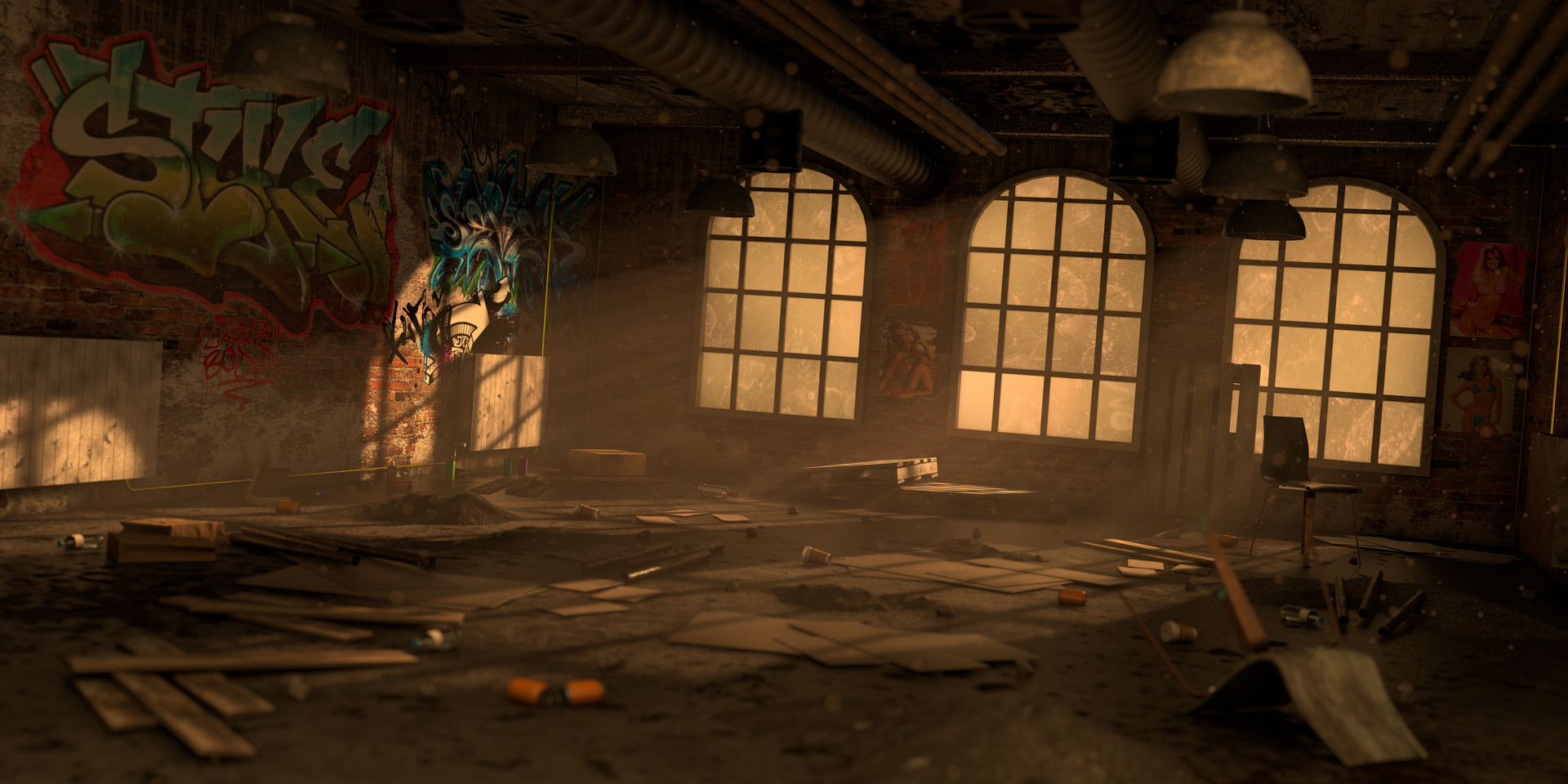
One of the first rooms inside the building.
The air smelled like old wood and dust. That was the first thing I noticed. The second thing was how empty the space felt. The room stretched farther than I expected, and the broken windows allowed long pale strips of daylight to slide across the floor. The walls were covered with peeling paint that curled outward in thin layers. Some sections had fallen away entirely, revealing rough boards underneath. I walked a few steps forward and listened carefully, half expecting to hear someone else moving somewhere deeper inside.
Nothing answered back except a faint creak from the floorboards beneath my shoes. That sound echoed slightly down a hallway I could see at the far end of the room. I pulled my phone from my pocket and glanced at the screen without thinking. The signal bars were gone completely. It was not surprising, but the sudden reminder that I had no reception made the building feel a little more isolated than it had a moment earlier.
I considered turning around right then. There was still daylight outside and no real reason to stay longer. But something about the room held my attention. The broken windows let in light at sharp angles, and the uneven boards of the floor interrupted the shadows in ways that created strange patterns across the surface. The more I looked, the more I began noticing details that would normally escape me if I were walking past a normal building on a normal street.
I didn’t realize at the time that stepping into that quiet room would lead to one of the strongest moments of art inspiration I have ever experienced.
At that point, though, the word inspiration was not what I was thinking about. Mostly I was listening for footsteps and wondering if someone might walk through the door behind me and ask why I was standing in a place that was clearly not open to the public. The building felt unstable in the way old structures sometimes do. Not collapsing, exactly, but tired. The ceiling beams sagged slightly in the middle, and pieces of plaster had fallen to the floor in scattered chunks.
I moved slowly toward the hallway at the far end of the room. The quiet followed me, thick and uneasy, broken only by the occasional creak of wood under my feet. The farther I walked, the more aware I became of how alone I was inside the structure. Without a phone signal and without anyone nearby who knew where I had gone, the building suddenly felt larger than it looked from the outside.
Still, the deeper I stepped into that hallway, the more I started noticing shapes and textures that made my artist brain wake up again. Cracked paint lines formed strange patterns along the walls. Rust stains bled downward from old nails like thin trails of dried ink. The floor near the hallway entrance had collapsed slightly in one corner, which caused the light from the windows behind me to bend across the boards at an angle I had never seen before.
I paused there longer than I should have. Fear and curiosity were pulling in opposite directions. One part of me kept saying I should leave before someone caught me wandering around inside an abandoned property. Another part of me was starting to realize that the building was full of visual details that most people would never slow down enough to see.
That was when I noticed the staircase.
It rose steeply from the end of the hallway, disappearing into the darker upper level of the building. The steps were uneven and worn, and several boards looked like they had shifted slightly over the years. Standing at the bottom of those stairs, I felt the uneasy mix of curiosity and caution that had followed me since I stepped through the front door.
I had not come looking for trouble. I had only been wandering around town hoping to fill a few empty pages in my sketchbook. Yet standing there in the dim hallway, staring at that crooked staircase, I began to sense that the building might contain far more visual surprises than the quiet room I had already walked through.
And against my better judgment, I started climbing.
Moving Deeper Inside
The staircase creaked the moment I placed my weight on the first step. The sound echoed farther than it should have, as if the building were hollow in ways I did not fully understand. I stopped immediately and listened. Nothing moved. No voices. No footsteps. Just the quiet settling of old wood and the faint whisper of wind pushing through the broken windows below.
I kept one hand lightly against the wall as I climbed. The paint had long since lost any smooth finish, and flakes broke away under my fingers like thin shells. Each step felt uncertain, not because the staircase was collapsing but because I could not shake the feeling that I had crossed into a place where people were not meant to linger. That thought alone made every small sound seem louder than it really was.
Halfway up the stairs I paused again and glanced back toward the room I had entered earlier. From this angle the strips of daylight cutting across the floor looked even stranger than before. The beams stretched in long shapes across the dust, bending around broken boards and scattered debris. I could already imagine the lines those shapes would make in a drawing. The longer I stared, the more the scene began shifting in my mind from something slightly dangerous into something visually interesting.
I realized then that this uneasy building might quietly become a place of art inspiration if I stayed long enough to really look at it.
The top of the staircase opened into a narrow landing that split into two directions. Both hallways looked darker than the floor below. A few broken windows let in small amounts of light, but most of the space felt dim and hollow. I took a few careful steps forward and noticed that the floor upstairs felt different under my shoes. The boards were softer somehow, like they had absorbed years of moisture.
That thought brought back the practical side of my brain. Old buildings can hide all kinds of problems. Rotten beams. Weak floors. Staircases that look solid but are barely holding together. I had no real plan beyond curiosity, and the lack of phone signal meant that if something did go wrong, I would have to deal with it alone. The sensible choice would have been to turn around and leave right then.
Instead I kept walking down the hallway.
The silence upstairs felt heavier than it had downstairs. Each step produced a small hollow knock that traveled ahead of me through the corridor. The walls were marked with years of damage. Long cracks ran across the plaster, and pieces had fallen away entirely in some places. Underneath, old wooden beams formed irregular lines that twisted across the surface. I caught myself studying those shapes the way I sometimes study tree branches or rock formations when I am looking for something interesting to draw.
It was strange how quickly my mind shifted from worry to observation. A few minutes earlier I had been thinking mostly about whether I might get caught trespassing. Now I was standing in a narrow hallway staring at the way rust stains had formed thin vertical lines beneath an old nail head. The pattern reminded me of ink dripping slowly down a page.
That was when the building began changing in my mind. Instead of feeling like a place I had wandered into by accident, it started feeling like a strange source of art inspiration hiding in plain sight.
I moved farther down the hallway and pushed open a door that had been hanging slightly ajar. The room inside was larger than the others I had seen so far. Broken window frames leaned inward at odd angles, and one entire section of the ceiling had collapsed, leaving a jagged opening that allowed daylight to pour through. Dust floated through the beam of light in slow drifting clouds.
The floor beneath that opening was scattered with fragments of plaster and splintered wood. I stepped carefully between them and looked upward. The edges of the broken ceiling created irregular shapes that overlapped with the light in complicated ways. Some parts of the room were bright while others fell into deep shadow only a few feet away.
I could not help picturing how that contrast would look in charcoal. Strong dark lines along the beams. Bright open space where the light cut through the dust. The more I stared, the more I felt that quiet pull artists sometimes experience when a scene begins arranging itself naturally into a composition.
Another creak sounded somewhere deeper in the building.
This time I froze completely.
The noise did not repeat, but it was enough to remind me again that I was alone inside a structure that clearly had not been maintained in a long time. The sound might have come from the wind or from shifting boards somewhere in the upper levels. Still, the uncertainty brought the earlier tension rushing back all at once.
I listened for nearly a full minute before taking another step. My eyes moved constantly between the doorway behind me and the dark corners of the room. The rational part of my mind kept reminding me that abandoned buildings often settle and shift in small ways, producing harmless noises that sound worse than they really are.
Even knowing that did not make the silence any more comfortable.
Eventually I moved back into the hallway and continued toward the far end where another faint strip of light showed beneath a partially open door. The corridor narrowed slightly as I walked, and the ceiling above dipped lower toward the middle. The farther I went, the more aware I became of how completely separated I was from the outside world.
No traffic noise. No passing voices. No phone signal.
Just the quiet breathing of an old building and the slow realization that places like this hold visual stories most people never stop long enough to notice.
And somewhere deeper inside, I had the growing feeling that the building was not finished revealing its art inspiration yet.
The Strange Beauty of the Interior
The hallway eventually opened into a wider room that must have once been used for something important. The ceiling rose higher here than anywhere else I had seen so far. Broken beams crossed above me like crooked ribs, and the remaining boards of the roof let thin columns of daylight fall through in scattered places. Dust moved slowly through those beams of light, drifting like pale smoke that had forgotten how to disappear.
I stepped carefully across the floor and paused near the center of the room. The longer I stood there, the more details began revealing themselves. At first it just looked like decay. Rotting wood. Rusted metal. Layers of paint curling away from the walls. But once my eyes adjusted to the dim light, the surfaces started forming shapes and patterns that felt strangely deliberate.
The peeling paint along one wall had lifted in long narrow strips that bent and twisted as they dried. Some pieces curled outward like thin paper ribbons. Others clung stubbornly to the wood beneath them. When the light from the broken ceiling touched those edges, the shadows formed delicate lines that looked almost like brush strokes stretching across the surface.
I caught myself staring longer than I meant to.
Artists sometimes talk about looking for beauty in unexpected places. I had heard that phrase plenty of times before, but standing inside that collapsing room gave the idea a completely different meaning. The damage around me was real and messy and uneven. Yet those very imperfections created textures that felt more interesting than the smooth surfaces people usually try to protect.
It was in that moment, standing beneath the broken roof, that the room truly became a source of art inspiration for me.
That thought did not arrive as a clear sentence in my head. It came as a quiet shift in attention. Instead of worrying about the building falling apart or someone suddenly appearing in the doorway behind me, my mind began studying the space the way it studies a subject before drawing. I started noticing relationships between shapes. The way rust stains followed the grain of the wood. The way light gathered along the edges of broken boards before fading into shadow.
Near the far wall an old metal cabinet leaned sideways against the plaster. The door had fallen off years ago, leaving the interior shelves exposed. Rust had spread across the surface in irregular patches that blended deep orange with dark brown. Some areas looked almost black where moisture had collected and dried repeatedly over time.
I walked closer and crouched beside it.
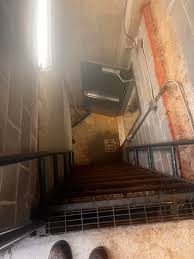
A staircase leading deeper into the building.
Up close the rust looked even more complex. Tiny ridges and pits covered the metal like rough skin. When a narrow beam of light from the ceiling struck the cabinet at an angle, those ridges produced thin highlights that zigzagged across the surface. The effect reminded me of dry riverbeds seen from above.
It was impossible not to imagine how those textures would translate into charcoal or ink.
I stood again and slowly turned in a full circle, taking in the rest of the room. Broken window frames hung at odd angles along the far wall. One pane of glass had somehow survived, though a long crack ran from corner to corner like a frozen lightning bolt. The crack divided the outside light into uneven segments that stretched across the floor in pale lines.
The floor itself told another story. Sections of wood had darkened from years of moisture, creating irregular patches that contrasted with the lighter boards nearby. When the dust shifted under my feet, faint outlines appeared where objects must have once stood long ago. Tables. Chairs. Machines maybe. It was impossible to know exactly what the room had been used for, but the ghost shapes remained faintly visible.
I realized then that abandoned places are not empty at all.
They simply hold their history in quieter ways.
The longer I stayed in that room, the more my earlier anxiety softened into curiosity. The building still felt unstable, and the risk of being caught inside had not disappeared. But the sense of unease was beginning to mix with something else now. Something creative and alert that artists recognize immediately when it appears.
I walked slowly toward another doorway at the far side of the room. The door itself had been removed entirely, leaving only the frame. Beyond it, another corridor stretched into darker parts of the building. The air drifting from that direction felt cooler somehow, carrying the faint smell of damp wood and old dust.
I hesitated before stepping through.
Part of me wondered how far the structure extended. Buildings like this sometimes connect to stairwells or storage areas that remain hidden from the main entrance. Another part of me wondered whether I was pushing my luck by exploring too deeply.
Still, the deeper parts of the building were beginning to feel like unexplored territory for my sketchbook.
And I could not ignore the quiet pull of that possibility.
So I stepped through the doorway and continued farther inside.
Farther Than I Meant To Go
The corridor beyond that doorway narrowed as it stretched deeper into the building. The ceiling lowered slightly and the walls leaned inward just enough to make the space feel tighter than the rooms behind me. My footsteps echoed in a dull hollow rhythm that followed me down the hall. Each step stirred faint clouds of dust that drifted through the thin streaks of light leaking in from cracked windows farther ahead.
I had stopped thinking about time by then. When you wander into places like that, the outside world fades faster than you expect. The usual noises of traffic and voices had disappeared completely. Even the wind seemed quieter inside those walls. The only sounds were the occasional creak of wood and the soft scrape of my shoes moving across the floor.
About halfway down the corridor I passed another room that had been partially blocked by fallen boards. A section of the wall had collapsed inward long ago, leaving a rough triangular opening where plaster and beams had broken apart. I leaned carefully around the debris to look inside.
The room beyond had once held machinery of some kind. I could tell from the heavy metal bolts still anchored into the floor. Whatever equipment had been there was gone now, but the marks it left behind remained etched into the boards. Circular stains surrounded the bolts where oil must have pooled years earlier. Rust had crept outward from the metal in jagged shapes that reminded me of branching rivers seen on a map.
Standing there, I felt the familiar shift again as the place turned quietly into another moment of art inspiration.
Not the kind people expect when they talk about landscapes or sunsets or dramatic city skylines. This was something quieter and stranger. The patterns of rust. The way dust settled along the edges of broken boards. The faint outlines left by machines that had not existed there for decades. It all formed a visual language that most people probably walked past without noticing.
I stepped away from the opening and continued toward the end of the hallway.
The floor dipped slightly as I walked, forcing me to move more carefully. One board flexed under my weight with a soft groan that made me pause immediately. I shifted my foot slowly backward and tested another section before continuing. The building was clearly older and weaker than it had first appeared.
For a moment I considered heading back downstairs.
Then the hallway opened into another room.
This one was darker than the others. Only a single window remained intact along the far wall, and even that glass had become cloudy with age. The light entering through it spread across the room in a soft gray glow that barely reached the opposite corner. The effect created a quiet gradient of shadow that deepened toward the back of the space.
I stepped inside and stood still, letting my eyes adjust.
The silence felt heavier there. Not threatening exactly, but thick. The kind of quiet that makes you aware of your own breathing. Somewhere above me a loose board shifted gently, probably stirred by the wind outside. The sound traveled down through the beams like a distant footstep.
It crossed my mind again that no one knew where I was.
That thought brought back the tension I had felt earlier near the entrance. Trespassing in abandoned places always carries a strange balance between curiosity and caution. You never know who might appear or what condition the structure might be in farther inside.
Still, even with that uneasy awareness lingering in the back of my mind, the room slowly revealed another quiet source of art inspiration.
The floor near the window had warped slightly over time. Several boards bowed upward while others dipped lower, creating a subtle wave across the surface. Dust had gathered along those raised edges in delicate lines that followed the curves of the wood. When the light from the cloudy window touched those ridges, the shadows formed repeating patterns that stretched across the floor like gentle ripples.
I crouched down to see them better.
From that lower angle the shapes became even more interesting. The lines overlapped in ways that suggested motion, almost like the movement of water. I could already imagine translating those curves into a sketch, using layered strokes to build the same rhythm across a page.
That was the moment I finally reached into my bag and pulled out the small sketchbook I had been carrying all afternoon.
Until then I had mostly been wandering and observing, letting the building unfold around me. But the longer I stayed in that dim room, the stronger the urge became to capture what I was seeing before the light changed or the feeling disappeared.
I flipped open the sketchbook and ran my fingers lightly across the blank page.
Standing there inside that quiet building, with dust drifting slowly through the air and shadows bending across the floor, I realized the place had quietly become one of the most unusual sources of art inspiration I had encountered in years.
And for the first time since stepping through the front door, the tension of the building faded just enough for me to begin drawing.
Sketching in the Silence
I sat down carefully on the edge of a low wooden beam that had fallen along the wall years earlier. It felt solid enough to hold my weight, though I still tested it with a slow shift of pressure before settling fully. The sketchbook rested on my knee while I pulled a pencil from the side pocket of my bag. For a few seconds I simply looked at the page without touching it, listening again to the quiet inside the building.
The strange thing about drawing in a place like that is how quickly the outside world disappears. A few minutes earlier I had been thinking about trespassing and unstable floors and the fact that my phone had no signal. Now the room in front of me had become the only thing that mattered. The warped boards beneath the window. The dust floating through the pale light. The cracked plaster curling away from the wall in small uneven ridges.
I started with the window.
Not the glass itself, which had become cloudy with age, but the faint beam of light it cast across the floor. Light is harder to draw than most people expect. You cannot actually sketch the light itself, only the surfaces it touches. So I began outlining the shapes of the boards and the raised ridges of dust that interrupted the beam as it stretched across the room.
The pencil moved slowly at first. My hand had that cautious feeling it sometimes gets when I am unsure whether a drawing will turn into anything worthwhile. But after a few minutes the lines began settling into place. The warped floorboards formed a gentle curve across the page, and the shadows beneath them created darker pockets where the light faded away.
I paused and glanced back at the real floor to compare what I had drawn.
It was not perfect. The angles were slightly off, and one section of the shadow felt heavier than it should have been. Still, the sketch had captured something of the quiet rhythm in the room. That was usually all I hoped for when working quickly on location.
The longer I sat there drawing, the more the building revealed details I had not noticed before. The beam of light shifted slightly as clouds moved outside, which caused the shadow along the wall to stretch farther across the floor. Dust particles caught the light and formed thin drifting streaks that looked almost like smoke.
I turned the page and started another sketch.
This time I focused on the cracked plaster along the wall beside the window. The surface had split into long uneven fragments that overlapped each other like scales. Some pieces had peeled outward just enough to create narrow shadows along their edges. When I traced those shapes with the pencil, the lines looked almost like broken leaves scattered across the surface.
The quiet in the room made every movement feel more deliberate. The scratch of the pencil against paper sounded louder than usual. Even the soft turn of a page seemed to echo slightly through the empty space. At one point I stopped drawing and simply listened again.
Nothing answered.
For the first time since entering the building, the silence felt less like a warning and more like a kind of shelter. No traffic. No voices. No phones buzzing with messages. Just the slow movement of air through cracked windows and the occasional creak of wood somewhere above the ceiling.
Artists spend a lot of time searching for places where they can concentrate long enough to really see what is in front of them. Studios help, of course, but they often come with their own distractions. Bills. Deadlines. The pressure to produce something finished. Sitting in that abandoned room with a sketchbook felt strangely different. The building expected nothing from me.
It simply existed.
I filled another page with rough lines of the fallen beam I was sitting on. The wood had splintered along one side where it must have struck the floor during the collapse. Those splinters created sharp triangular shapes that pointed in different directions like arrows. When I sketched them, the jagged lines added a tension to the drawing that felt completely natural.
Every now and then I glanced toward the doorway, half expecting someone to appear there and ask what I was doing. That possibility never fully left my mind. The building might have been empty, but I was still aware that I did not belong inside it.
Even so, the longer I stayed, the more comfortable the act of drawing became.
I worked through several pages without paying much attention to time. Some sketches were quick impressions of textures along the wall. Others focused on the geometry of the floorboards or the way light gathered around the edges of debris scattered near the doorway.
Eventually the pencil paused in my hand.
I leaned back slightly and studied the open sketchbook resting across my knee. The pages were rough and unfinished, but they carried something the blank book had not possessed earlier that afternoon. They carried the marks of a place most people would never think to draw.
That realization made me look around the room again with fresh attention.
The building had felt intimidating when I first stepped through the door. It had seemed unstable, quiet in a way that made every sound feel suspicious. Yet somewhere along the way the place had turned into something else entirely.
Not safe exactly.
But strangely generous.
For a while I forgot about leaving. I simply sat there sketching while the pale afternoon light shifted slowly across the warped floor.
Walking Back Into the Light
I eventually realized the light in the room had shifted farther than I expected. The beam from the cloudy window had slid several inches across the floor, and the dust drifting through it had grown thinner as the afternoon moved on. I flipped through the sketchbook slowly, looking at the pages I had filled while sitting on the fallen beam. None of the drawings were finished pieces, but they carried something that had been missing earlier in the day.
They carried the feeling of the place.
I closed the sketchbook and slid the pencil back into the pocket of my bag. For a moment I simply sat there listening again to the building. The silence felt familiar now, though it still held that faint edge of uncertainty that had followed me since I stepped inside. Somewhere above me a loose board shifted softly. The sound traveled down through the beams and faded again.
That was enough to remind me that it was probably time to leave.
I stood carefully and brushed a thin layer of dust from my jeans. The room looked slightly different now that I had spent time studying it. Details that once seemed random had started to feel organized in a quiet way. The warped boards near the window. The cracked plaster along the wall. Even the scattered fragments of debris on the floor had begun forming patterns in my memory.
I took one last look around before stepping back into the hallway.
The corridor seemed darker than before, though that might have been because my eyes had adjusted to the soft light in the room behind me. As I walked toward the staircase, the familiar creaks of the floorboards returned beneath my steps. Each sound echoed gently along the walls and faded into the distance.
For a moment I paused halfway down the hall and glanced back over my shoulder.
The doorway to the room I had been drawing in stood quietly behind me. Dust floated through the beam of light spilling across the floor. The scene looked almost exactly the same as it had when I first entered, yet it felt completely different now.
Not because the building had changed.
Because I had.
I continued down the hallway and reached the staircase again. The steps looked just as steep as they had earlier, though descending them somehow felt easier than climbing them had been. I moved slowly, placing each foot carefully along the worn boards. The stairwell carried the faint smell of old wood and dry plaster.
When I reached the bottom step, the larger room near the entrance came back into view.
The long strips of daylight still stretched across the floor where the broken windows allowed them through. From this angle the patterns of light and shadow looked even more dramatic than I remembered. I almost pulled the sketchbook out again just to capture one more quick drawing.
Instead I stood there quietly for a few seconds.
The place had felt intimidating when I first stepped inside. It had seemed unstable, silent, and uncertain in ways that made me question whether entering had been a good idea. Yet somewhere during that uneasy exploration, the building had revealed something else entirely.
It had revealed a different way of looking.
Artists often spend time searching for perfect subjects. Landscapes with dramatic views. Streets filled with color and movement. Carefully arranged still life scenes in controlled lighting. Those places certainly have their value. But standing there in that empty room made me realize something simpler.
Interesting things exist everywhere.
Most of the time we simply walk past them.
I stepped across the dusty floor and reached the crooked front door. The outside air felt cooler as it drifted through the opening. When I pushed the door wider, the ordinary sounds of the street returned all at once. A distant car passed somewhere beyond the block. Wind moved through the nearby trees.
The daylight outside looked brighter than I expected after spending so long inside the dim building.
I walked out onto the cracked pavement and turned back once more to look at the structure behind me. From the street it looked quiet and forgettable again. Just another aging building slowly fading from attention.
No one passing by would guess what I had found inside.
I adjusted the strap of my bag and started walking down the sidewalk. The sketchbook inside it felt slightly heavier now, though that was probably just my imagination. A few unfinished drawings rested between those pages, along with the memory of the quiet room where they were made.
As I reached the end of the block, I glanced once more at the building disappearing behind the trees.
Sometimes the most unlikely places become the strongest sources of art inspiration.
You just have to be curious enough to step inside.